

SPONSORED POST

Here’s how CPUs are enabling AI agents in the data center
As AI evolves into the agentic era with always-on workflows that plan, reason, and act, the CPU is stepping back into the spotlight as the system’s orchestration engine. While GPUs handle the heavy AI math, the right CPU determines how quickly agents can juggle tools, memory, I/O, security, and real-time decisions at scale.
For five generations, AMD has been the industry standard in CPU leadership. AMD EPYC™ Server CPUs are purpose-built to run efficient agentic AI alongside all your other data center workloads. Read on to see the key CPU features and performance metrics that make a difference.
1. High core and thread density
With more threads, your CPUs can manage more agents Agentic platforms may run thousands of agent threads concurrently. CPUs must be ready to prepare data, orchestrate tasks, and handle microservices on a massive scale. The more cores and threads in a CPU, the more agents it can support. In addition to high core counts, AMD EPYC Server CPUs feature Simultaneous Multithreading (SMT), which executes two threads per core.
- 5th Gen AMD EPYC™ Server CPUs currently have the highest available core count in x86 server processors with 192 cores (up to 384 threads).
- The upcoming 6th Gen AMD EPYC Server CPUs will offer up to 256 cores (up to 512 threads).
- 2.1X higher performance per core with a 5th Gen AMD EPYC™ Server CPU-based system compared to NVIDIA Grace™ CPU Superchip-based systems. [1]
2. Multiple CPU performance options
Match a broad range of agentic workloads
You may need different CPU configurations to support different agentic workloads. High-frequency CPUs can maximize performance per core for latency-sensitive agents and fast orchestration logic. High throughput per core can make your agents highly efficient when handling multiple, simultaneous tasks.
With AMD EPYC Server CPUs, you can choose from a wide range of core counts and frequencies to optimize for specific goals.
- AMD EPYC™ 9005 Server CPUs deliver 2.3X the performance when compared to leading competitive offerings. [2]
White paper: The Agentic AI era and the CPU infrastructure that will power IT
Discover how Agentic AI is transforming infrastructure demands and why AMD EPYC CPUs are becoming essential for scalable, autonomous AI workloads.
3. Large memory capacity and bandwidth
Support long-context pipelines and rapid data retrieval AI agents typically manage complex, multi-step tasks, often over an extended period. CPUs with large memory capacity and bandwidth can support agentic workflows involving vector databases, retrieval-augmented generation (RAG) pipelines, and other memory‑intensive tasks.
- 5th Gen AMD EPYC Server CPUs support 12 DDR5-6400 memory channels (up to ~600 GB bandwidth) and up to 384 MB L3 cache.
- The upcoming 6th Gen AMD EPYC Server CPUs will support up to 2.6X the memory bandwidth (1.6 TB/s) over the previous generation.
4. Fast input/output (I/O)
Avoid bottlenecks with high-speed I/O
Agents require constant, high-speed interaction between processors, APIs, databases, and other network resources. Fast interconnect, including the latest generations of PCIe®, helps CPUs connect to data, tools, NVMe storage drives, and host nodes without delays.
- 5th Gen AMD EPYC Server CPUs offer up to 160 PCIe Gen 5 lanes.
- The upcoming 6th Gen AMD EPYC Server CPUs will offer ~2X more I/O bandwidth over the previous generation with PCIe Gen [6].
5. High performance per watt
Maximize power efficiency with a high number of threads per watt
While agentic workloads are booming, data center architects are struggling to manage power consumption and cooling. AMD EPYC Server CPUs are optimized for performance per watt and threads per watt, which helps IT teams add capacity for agents within space and power constraints.
- A system with a 5th Gen AMD EPYC Server CPU delivers a 2.26X uplift on SPECpower®, measuring operations per watt against a comparable NVIDIA Grace Superchip-based system. [3]
- AMD EPYC 9005 Server CPUs offer energy-efficient server solutions with exceptional performance. For example,2P servers using AMD EPYC™ 9965 CPUs deliver 1.6X more performance per system watt than Intel® Xeon® 6980P CPUs running SPECpower_ssj®2008. [4]
Extensive range to fit your agentic AI goals
Agentic AI will require CPUs to do more than ever, and there’s no one-size-fits-all solution. AMD offers a broad and flexible CPU portfolio, x86 compatibility, and an open-source ecosystem to minimize software friction. By balancing core and thread count, frequency, memory, I/O, and performance per watt, you can add capacity for agents while managing costs.
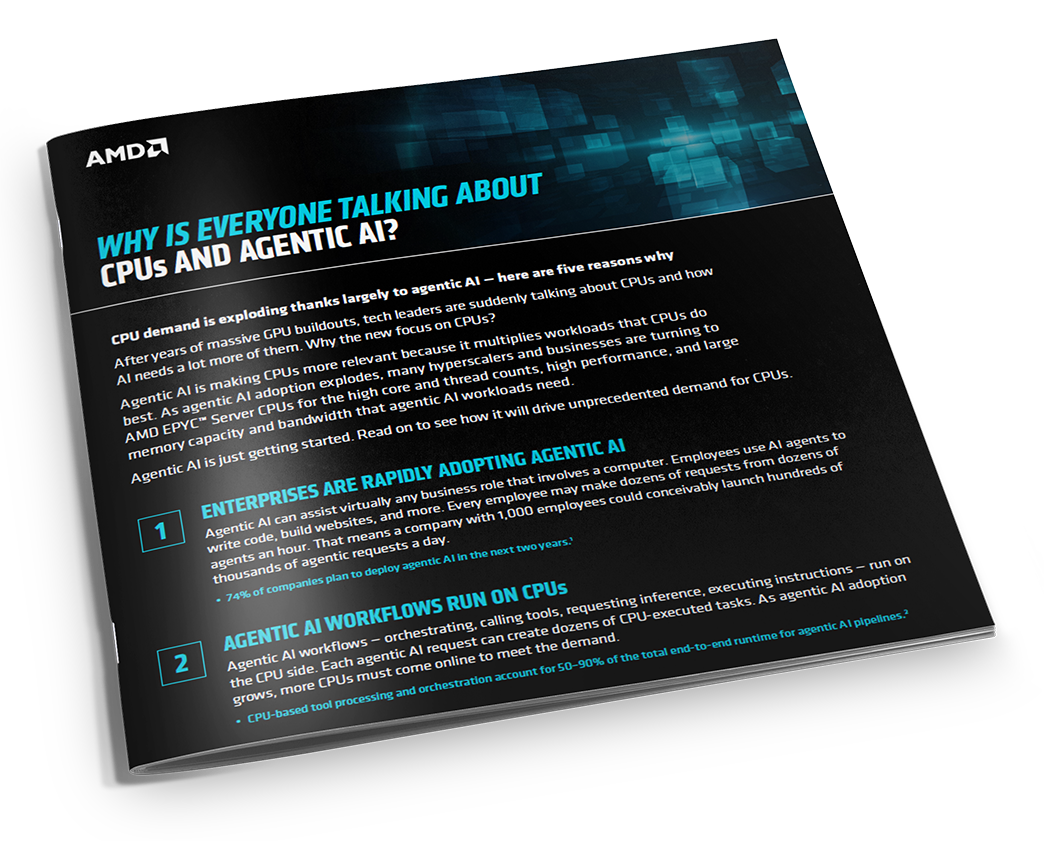
Why is everyone talking about CPUs and Agentic AI?
CPU demand is exploding thanks largely to agentic AI — here are five reasons why After years of massive GPU buildouts, tech leaders are suddenly talking about CPUs and how
AI needs a lot more of them. Why the new focus on CPUs?
Agentic AI is making CPUs more relevant because it multiplies workloads that CPUs do best. As agentic AI adoption explodes, many hyperscalers and businesses are turning to
AMD EPYC™ Server CPUs for the high core and thread counts, high performance, and large memory capacity and bandwidth that agentic AI workloads need.
Agentic AI is just getting started. Read on to see how it will drive unprecedented demand for CPUs.
- Enterprises are rapidly adopting Agentic AI
- Agentic AI workflows run on CPUs
- One Agentic AI request can spawn a deluge of AI agents
- Search engines, databases, CRM, ERP — everyday systems must scale up to meet agentic demand
- Agentic AI drives more inference
Agentic AI is already driving massive demand for CPUs. Based on that surge, AMD now projects the total addressable market (TAM) for CPUs to roughly quadruple by 2030. [10]
AMD is helping to drive the next phase of AI infrastructure with our 5th Generation AMD EPYC™ Server CPUs. Even more workload-specific performance for agentic AI will be possible with our 6th Generation AMD EPYC™ Server CPUs, slated to be available in the second half of 2026.

Performance-related Details
1.
2.
9xx5-002F: SPECrate®2017_int_base comparison based on published scores from www.spec.org as of 12/11/2025. 2P AMD EPYC 9965, 192C, 500W, $11988 USD, 3230, 6.460, 0.269, https://www.spec.org/cpu2017/results/res2025q2/cpu2017-20250324-47086.html 2P Intel Xeon 6780E, 144C, 330W, $8513 USD, 1420, 4.303, 0.167, https://www.spec.org/cpu2017/results/res2025q4/cpu2017-20251020-50067.html SPEC®, SPEC CPU®, and SPECrate® are registered trademarks of the Standard Performance Evaluation Corporation. See www.spec.org for more information. AMD CPU prices as of 12/11/2025.
3.
4.
9xx5-134: SPECpower_ssj® 2008 comparison based on published scores from www.spec.org as of 4/30/2025. 2P AMD EPYC 9965 (35920 ssj_ops/watt, 384 Total Cores, https://spec.org/power_ssj2008/results/res2024q4/power_ssj2008-20241007-01464.html) 2P Intel Xeon 6980P (21679 ssj_ops/watt, 256 Total Cores, https://spec.org/power_ssj2008/results/res2025q2/power_ssj2008-20250324-01511.html) SPEC®, SPEC CPU®, and SPECpower® are registered trademarks of the Standard Performance Evaluation Corporation. See www.spec.org for more information.
5.
AMD, AMD Financial Analysts Day, November 11, 2025 and Q1 2026 AMD Earnings Call.
© 2026 Advanced Micro Devices, Inc. All rights reserved. AMD, the AMD Arrow logo, EPYC, and combinations thereof are trademarks of Advanced Micro Devices, Inc. in the United States and other countries. PCIe is a trademark of PCI-SIG. Other product names used in this publication are for identification purposes only and may be trademarks of their respective owners.
Know-how about digitalisation, servers and storage

NIS2 made easy: Immutable storage contributes to compliance
The new NIS2 Directive presents companies with the challenge of enhancing their cybersecurity measures and ensuring data integrity. With immutable storage, businesses can ensure that critical data is permanently protected and cannot be altered. This technology not only provides increased security but also meets the stringent requirements of NIS2.
Discover how immutable storage can help your company comply with the directive while safeguarding your sensitive information.


NIS2 Directive: Cybersecurity requirements and impact on businesses
There are many reasons why companies have cause for concern these days —…

Europe’s digital sovereignty:
between ideal and business reality
Digital sovereignty is more than just a buzzword: it determines control over…

Custom IT solutions for future-proof IT infrastructure
A one-size-fits-all approach simply doesn’t work when organizations have…

Making IT safe
This October is European Cybersecurity Awareness Month which draws particular…

High performance computing in automotive engineering
In the world of automotive engineering, simulations are a central building…